
Indonesia has reclaimed more than four million hectares of land that had been illegally used for plantations, mining and other commercial activities inside officially designated forest areas, government officials said. The large-scale enforcement drive, described as the most extensive forest crackdown in the country’s history, has raised major questions about the legality of oil palm plantations, the future of seized land and the lack of clarity surrounding ecological restoration.
The operation is being led by a special task force established in January 2025 by President Prabowo Subianto. The year-old task force brings together the military, police, prosecutors and several ministries to enforce forest protection laws that have historically been weakly implemented. Officials say the task force had initially aimed to reclaim one million hectares in 2025 but has exceeded that target by more than four hundred percent within its first ten months.
The reclaimed land spans oil palm plantations, mining concessions including nickel and coal sites, and conservation areas such as protected forests and national parks. Authorities say enforcement actions have focused on plantations operating without forest-area permits, mining projects lacking legal approval, unlicensed gold mining, tourism facilities built illegally inside protected zones and oil palm encroachment into national parks.
Enforcement far exceeds original targets
Government officials say the task force has already reclaimed land equivalent in size to Switzerland, far surpassing its original mandate. President Prabowo has indicated that this may only be the beginning, suggesting that another four to five million hectares could be taken over in the coming months, citing decades of unchecked forest encroachment.
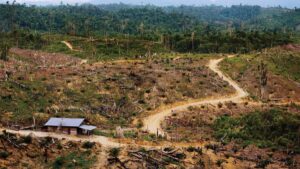
However, the unprecedented scale of the land seizures has exposed unresolved questions about how much of the reclaimed land consists of oil palm plantations and how the government is determining illegality. In 2019, Indonesia’s environment ministry estimated that around 3.4 million hectares of oil palm plantations overlapped with forest zones. If the government’s current figures are accurate, it would imply that more than half of Indonesia’s estimated 17 million hectares of oil palm plantations could be problematic.
Officials say the reclaimed land includes both plantations and mining areas, but mining concessions cover far less land than oil palm estates, leaving experts questioning how the figures were calculated and on what legal basis large areas are being classified as unlawful.
Civil society groups have raised concerns about the lack of transparency. Environmental watchdogs say the government has not adequately explained how the data behind the seizures was compiled, creating uncertainty and mistrust around the campaign’s scope.
Billions recovered, but future use remains unclear
The task force has collected approximately 2.3 trillion rupiah, or about 136 million US dollars, in administrative fines from 20 oil palm companies and one nickel mining firm. The funds were formally handed over to the finance ministry during a public ceremony in Jakarta in December 2025. Yet the government has not clarified how the money will be used, nor how it will contribute to forest protection or restoration.
While officials say administrative penalties are being prioritised, criminal prosecution remains a possibility for companies that fail to cooperate. What remains uncertain is the fate of the seized plantations and mining sites themselves.
Under a 2025 presidential regulation that provides the legal framework for reclaiming illegally used forest land, penalties and enforcement mechanisms are outlined, but post-seizure land management is not clearly defined. This ambiguity, experts warn, creates room for misuse and weak oversight.
In practice, around 1.7 million hectares of seized oil palm land have been handed over to state-owned palm oil company PT Agrinas Palma Nusantara. This transfer has rapidly transformed the company into the world’s largest palm oil producer by land area. Other parcels of land, including conservation forests and parts of Tesso Nilo National Park in Sumatra, have been returned to the Ministry of Forestry for restoration.
Based on official figures, less than one-fifth of the reclaimed land has been earmarked for ecological recovery so far. Around 1.6 million hectares remain under verification and law enforcement review before being formally transferred to the state.
Restoration and community rights remain sidelined
Environmental experts warn that the limited focus on restoration risks turning a conservation effort into a purely economic exercise. Critics argue that reclaiming land without repairing damaged ecosystems undermines forests’ role in protecting biodiversity and reducing flood and landslide risks, especially in peatland regions.
Although ecological restoration is listed as a mandate of the task force, civil society groups say it has been largely neglected. They also warn that continued oil palm cultivation on seized land under state management could entrench environmental damage rather than reverse it.
Concerns have also emerged over potential conflicts with local and Indigenous communities. The presidential regulation allows land to be reclaimed as a state asset without prior verification of customary or smallholder land rights, a provision that critics say does not align with existing forest laws. Reports of rising tensions have followed land transfers to Agrinas, particularly where community land overlaps remain unresolved.
Task force officials insist the crackdown targets illegally converted forest land and not legitimate community-owned plantations. They say mechanisms are in place for communities to report wrongful seizures and that relocation and alternative livelihoods are being prepared in sensitive areas such as national parks.
Despite these assurances, experts stress that transparency, public data disclosure and meaningful community participation are essential if the campaign is to deliver lasting environmental protection rather than simply redistributing control of land.
Indonesia’s forest enforcement drive marks a turning point in how the country addresses decades of illegal land conversion. Whether it becomes a genuine conservation success or a source of new ecological and social conflict will depend on how restoration, accountability and community rights are handled in the months ahead.