
India celebrated its 77th Republic Day on January 26, 2026, with a grand parade at Kartavya Path in New Delhi, highlighting the country’s growing military capability, technological self-reliance and constitutional values. The celebrations witnessed an impressive display of advanced weapon systems, aerial formations and cultural tableaux from across the nation.
Group Captain Shubhanshu Shukla was honoured with the Ashok Chakra ahead of the parade. He made history last year by becoming the first Indian to visit the International Space Station, marking a significant milestone for India’s space and defence journey.
Advanced Missile Systems and Fighter Jets Dominate the Republic Day Parade
The parade showcased key defence assets developed by the Defence Research and Development Organisation, including the Long Range Anti-Ship Missile, BrahMos supersonic cruise missile, Akash air defence system and the Suryastra Universal Rocket Launcher System. Artillery platforms such as the Dhanush 155 mm towed gun and the Advanced Towed Artillery Gun System were also displayed, reflecting India’s focus on indigenous defence manufacturing.
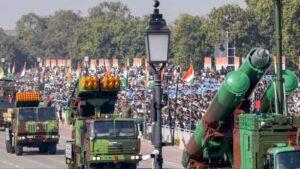
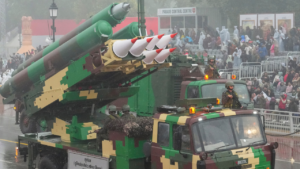
The aerial display drew special attention as Rafale fighter jets flew over Kartavya Path at speeds touching 900 kilometres per hour. Apache helicopters and Indian Air Force formations, including the Vajraang and Vijay formations, underlined the operational strength of the armed forces. Helicopters carrying the flag of Operation Sindoor also featured prominently during the flypast.
Cultural Tableaux Reflect India’s Diversity and the Theme of Vande Mataram
A total of 30 tableaux rolled down Kartavya Path, including 17 from states and Union Territories and 13 from central ministries and departments. This year’s Republic Day theme, “150 Years of Vande Mataram,” was reflected across the presentations. Punjab’s tableau marked the 350th year of martyrdom of Sri Guru Tegh Bahadur Sahib Ji, while Gujarat highlighted the role of Vande Mataram in inspiring the Swadeshi movement and India’s freedom struggle.
Other states such as Maharashtra, Himachal Pradesh, Manipur, Odisha, Madhya Pradesh and Nagaland showcased their cultural heritage, traditional art forms and contributions to nation-building. The celebrations reaffirmed the significance of January 26, the day the Constitution of India came into effect in 1950, officially establishing India as a sovereign democratic republic.