
An intense Arctic cold wave has plunged large parts of Canada into dangerously low temperatures, transforming Niagara Falls into a rare and dramatic winter spectacle. With wind chill values dropping close to minus 55 degrees Celsius, one of the world’s most powerful waterfalls now appears almost frozen in time, drawing global attention while raising serious safety concerns.
The brutal cold spell has sent shockwaves across North America, with icy air spilling south into the United States. Authorities on both sides of the border have issued warnings as extreme conditions disrupt daily life, infrastructure, and tourism.
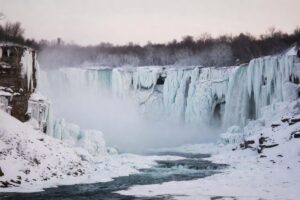
Visitors arriving at Niagara Falls are met with an otherworldly scene. Thick ice coats railings, trees, and observation decks, while constant mist from the cascading water freezes instantly on contact. From afar, the famous Horseshoe Falls resemble a massive frozen curtain, with towering ice shelves stretching across the river below.
Although the falls look motionless in places, water continues to surge beneath the ice. The usual thunderous roar is muted, absorbed by layers of ice several metres thick, creating an eerie silence more reminiscent of the Arctic than a bustling tourist landmark.
How the Arctic Blast Pushed Temperatures to Extremes
Meteorologists link the deep freeze to a powerful surge of Arctic air driven far south by shifting atmospheric patterns. In several Canadian regions, actual air temperatures have hovered between minus 30°C and minus 40°C, while strong winds have pushed “feels like” temperatures down to minus 55°C.
Under these conditions, exposed skin can freeze within minutes. Schools have delayed openings, outdoor work has been restricted, and warming centres have been opened for vulnerable residents. The constant spray from the falls, combined with fierce winds, has accelerated ice formation, creating ideal conditions for the near-frozen spectacle.
Is Niagara Falls Really Freezing Solid?
Despite viral images suggesting the waterfalls have stopped, experts say Niagara Falls almost never freeze completely. The sheer volume of water flowing from the Great Lakes ensures that powerful currents continue beneath the ice. What visitors see is a frozen shell masking a still-raging river.
Historically, parts of the American Falls have appeared nearly iced over during extreme winters, particularly in the early 20th century. Even then, water continued to move beneath the surface, with true stoppages usually caused by upstream ice jams rather than freezing alone.
Tourism Draws Crowds Despite Dangerous Conditions
The frozen spectacle has not stopped tourists from arriving, cameras in hand. Many brave the cold only briefly before retreating to heated visitor centres, eyelashes and scarves crusted with frost. Boat tours have been suspended, and some walkways have closed as ice turns paths into hazardous surfaces.
Local businesses report mixed impacts. While some travellers cancel due to unsafe roads, others arrive spontaneously, drawn by social media images of the frozen falls before temperatures rise again.
Beyond the Beauty: Risks to Communities and Infrastructure
Away from the dramatic scenery, the cold snap poses serious risks. Power demand has surged as heating systems run nonstop, raising concerns about grid stability. Frozen pipes threaten homes and public buildings, while homeless shelters across Ontario are operating at or beyond capacity.
Transport networks are under strain as ice fog and freezing precipitation reduce visibility and make driving treacherous. Airports prepare for delays as de-icing operations slow departures, especially on regional routes.
Why Extreme Cold Still Happens in a Warming Climate
Scenes like a semi-frozen Niagara Falls often spark confusion about climate change. Scientists stress that global warming does not eliminate extreme cold events. Instead, it can alter atmospheric patterns, sometimes allowing Arctic air to plunge unusually far south.
Research continues into how Arctic warming may affect the polar vortex, potentially increasing the intensity or unpredictability of cold outbreaks. At the same time, long-term data show that average winter temperatures across North America are rising, even as occasional brutal cold snaps persist.
For now, Niagara Falls stand as a striking symbol of winter’s raw power. As temperatures slowly climb, the ice will crack and collapse back into the river. Until then, the near-frozen falls offer a breathtaking, and sobering, reminder of nature at its most extreme.