
Deep beneath the icy, lightless waters of the Arctic and North Atlantic oceans, an ancient predator glides silently through the depths. The Greenland shark, one of the most mysterious creatures on Earth, has stunned scientists by rewriting the limits of animal lifespan. Living for centuries, it is officially the longest-lived vertebrate ever discovered.
Some Greenland sharks alive today may have been born before the Industrial Revolution, long before modern nations existed. Their extraordinary longevity has made them a subject of intense scientific fascination, offering rare insights into ageing, endurance, and survival in extreme environments.
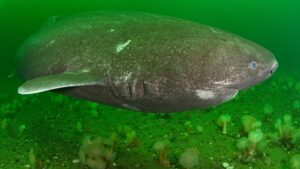
For decades, researchers struggled to determine the age of Greenland sharks because they lack bones or scales that typically reveal age through growth rings. A scientific breakthrough came when researchers analyzed proteins in the sharks’ eye lenses. These proteins form before birth and remain unchanged throughout life.
Using radiocarbon dating, scientists discovered that Greenland sharks commonly live 250 to 400 years, with some individuals estimated to be even older. This finding crowned the Greenland shark as the longest-living vertebrate known to science.
Childhood That Lasts Over a Century
The shark’s slow life strategy is unlike anything seen in other animals. Greenland sharks grow at an incredibly slow rate of about one centimeter per year. Most remarkably, they do not reach sexual maturity until around 150 years of age.
This means the sharks spend more than a century as juveniles before they can reproduce. Such an extended development period reflects a biological strategy focused on survival and endurance rather than speed or rapid reproduction.
The secret to the Greenland shark’s longevity lies largely in its environment. Living in near-freezing waters dramatically slows the shark’s metabolism. With reduced heart rate, digestion, and cellular activity, the body experiences far less biological stress over time.
This slow metabolic pace minimizes cellular damage, allowing the shark’s body to function efficiently for centuries. In effect, the cold ocean acts as a natural life-extending mechanism.
Genetic Protection Against Ageing
Recent genetic research suggests that Greenland sharks possess exceptional DNA repair mechanisms. These allow them to avoid many of the age-related diseases, such as cancer and cellular decay, that affect most animals.
Scientists believe the species may exhibit what is known as “negligible senescence,” meaning they show little to no biological decline as they age. Understanding these genetic traits could help researchers unlock new knowledge about ageing in humans.
Once believed to be nearly blind due to eye parasites, Greenland sharks have proven to be well-adapted hunters. Studies of their retinal structure reveal that their eyes are capable of detecting faint light in deep ocean conditions.
Even after living for hundreds of years, their sensory systems remain functional, enabling them to navigate and survive in one of the harshest habitats on the planet.
Slow Reproduction, High Risk
Greenland sharks reproduce extremely slowly. They are believed to be viviparous, meaning embryos develop inside the mother, possibly for several years. This slow reproductive cycle makes the species highly vulnerable to overfishing and environmental change.
If populations decline, recovery could take centuries, as there are few young adults available to replace older individuals.
The Greenland shark is not just a scientific curiosity it is a warning. Its slow growth and reproduction mean that human activity can have long-lasting consequences. Climate change, deep-sea fishing, and pollution pose serious threats to a species that depends on stability over centuries.
Protecting the Greenland shark requires conservation strategies that extend far beyond human lifespans.
The Greenland shark stands as a living reminder of Earth’s deep past. By thriving where few creatures can, it challenges our understanding of ageing and survival. As scientists continue to study its biology, this ancient ocean wanderer may one day help humanity understand how life itself can endure for centuries.