
At least 132 people have been killed and more than 480 injured after a powerful magnitude 7.4 earthquake struck western Colombia, triggering widespread building collapses and prompting the government to declare a national disaster.
The earthquake struck at 7:34am local time on Monday at a depth of about 103 kilometres, according to Colombia’s geological service. The epicentre was near San José del Palmar in Chocó province, but the tremor was felt across a large part of the country and in neighbouring Venezuela, Ecuador and Panama.
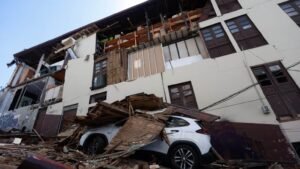
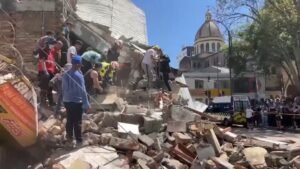
The death toll is expected to rise as rescue teams continue searching collapsed buildings for survivors.
Pereira, located about 55 kilometres from the epicentre, has suffered some of the worst damage. Local authorities reported at least 40 deaths in the city’s metropolitan area, along with 65 collapsed buildings. People are believed to remain trapped in 15 structures.
Videos verified by the BBC showed a building collapsing in Plaza Bolívar, Pereira’s main square, sending debris and dust across the area.
Cali, Colombia third largest city, was also badly affected, with 32 buildings reported to have collapsed. Rescue and recovery operations are underway as authorities assess the scale of the destruction.
Deaths and damage have also been reported in Manizales, Quibdó and Medellín, as well as across the Chocó and Valle del Cauca regions. At least two people were reported dead in Manizales, where residents described walls cracking and bricks falling during the shaking.
The earthquake also affected critical infrastructure. Colombia’s aviation authorities reported damage at regional airports in Pereira, Manizales, Quibdó, Armenia, Cartago and Buenaventura. In Bogotá, hundreds of kilometres from the epicentre, residents reported violent shaking, with some buildings developing cracks and people evacuating as a precaution.
Colombian President Abelardo de la Espriella declared a national disaster situation, giving the government additional powers to respond to the emergency and reallocate funds. He said more than 1,500 homes had been damaged.
International support has also been offered. US Secretary of State Marco Rubio said Washington was monitoring the situation and was ready to assist. European Commission President Ursula von der Leyen said the EU’s Copernicus satellite system was being used to support rescue efforts. El Salvador also offered personnel and equipment.
The US Geological Survey estimated that around 1.5 million people experienced shaking close to magnitude seven.
Although the earthquake occurred at considerable depth, scientists noted that deep earthquakes can still cause serious damage because of the way their energy reaches the surface. Such earthquakes may produce fewer aftershocks, but some can still be strong enough to threaten damaged structures.
Rescue teams are continuing to search collapsed buildings as authorities work to determine the full extent of casualties and damage.